Important Details
IJCRT - International Peer Reviewed, Open Access Journal, Multidisciplinary, Monthly, Nominal(Low) Fees for Professional Research Services International Journal of Creative Research Thoughts - IJCRT Peer Review Journal, Refereed Journal, Peer Reviewed Journal , Referred Journal and Indexed Journal, Open access, Online and Print Journal,international Journal Open Access, Accepted by Indian and foreign university ,IJCRT Followed Norms, guidelines, requirement, listing criteria and methodology of score/point also applied from: Scopus , Web of Science , UGC Approved , UGC CARE, UGC-CARE .
UGC Approved Journal No: 49023 (18)
UGC approval Link
https://ijcrt.org/ugc%20approval.jpg
All Policy and Approval
Please Like Our Facebook Page | CrossRef DOI and Hard copy of Certificate Provide if required. | www.IJCRT.org | editor@IJCRT.org | IJCRT WhatsApp +91 94294 58311
Publication Details:
- Paper Submission : 31-Oct-2026. Call For Paper (Volume 14 | Issue 9 | Month- September 2026)
- Acceptance/Rejection Notification: Within 02-04 Days.
- Paper Publish: Within 02-04 Days after submitting all documents.
-
Submit Your Paper Any time There No deadline.
-
Publication fees : 1570 INR for Indian author & 59$ for foreign International author.
Please Like Our Facebook Page | CrossRef DOI and Hard copy of Certificate Provide if required.
Licence and Indexing
Indexing In Google Scholar, SSRN, ResearcherID-Publons, Semantic Scholar | AI-Powered Research Tool, Microsoft Academic, Academia.edu, arXiv.org, Research Gate, CiteSeerX, ResearcherID Thomson Reuters, Mendeley : reference manager, DocStoc, ISSUU, Scribd, and many more | High Impact Factor: 7.97 | Digital object identifier (DOI) and Hard Copy of certificate Provided.




























Licence
DOI
ISSN Approved impact factor: 7.97 
Creative Common 
Valid as per new UGC Gazette regulations 

INTERNATIONAL JOURNAL OF CREATIVE RESEARCH THOUGHTS - IJCRT (IJCRT.ORG)
International Peer Reviewed & Refereed Journals, Open Access Journal
IJCRT Peer-Reviewed (Refereed) Journal as Per New UGC Rules.
ISSN Approved Journal No: 2320-2882 | Impact factor: 7.97 | ESTD Year: 2013
Call For Paper - Volume 14 | Issue 9 | Month- September 2026
Scholarly open access journals, Peer-reviewed, and Refereed Journals, Impact factor 7.97 (Calculate by google scholar and Semantic Scholar | AI-Powered Research Tool) , Multidisciplinary, Monthly, Indexing in all major database & Metadata, Citation Generator, Digital Object Identifier(CrossRef DOI)
IJCRT WhatsApp Contact
IJCRT Search Xplore - Search all paper by Paper Name , Author Name, and Title
Volume 14 | Issue 8 |
Volume 14 | Issue 8 | Month
Downlaod After Publication 1) Table of content index in PDF
2) Table of content index in HTML 2)Table of content index in HTML
3) Front Page 3) Front Page
4) Back Page 4) Back Page
5) Editor Board Member 5)Editor Board Member
6) OLD Style Issue 6)OLD Style Issue
 |
 |
|---|---|
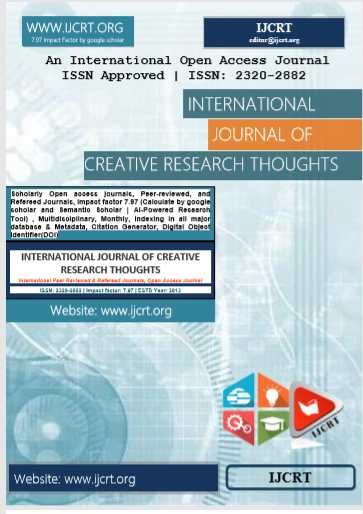
| IJCRT Journal front page | IJCRT Journal Back Page |
Paper Title: Indian Immigrant Students in Canada: Interpersonal Communication and Cross-Cultural Issues
Author Name(s): Mohd Tauseef, Mohd Faizan Raza, Dr.Shakira Khatoon, Pratiksha Prajapati
Published Paper ID: - IJCRT2608218
Register Paper ID - 312644
Publisher Journal Name: IJPUBLICATION, IJCRT
DOI Member ID: 10.6084/m9.doi.one.IJCRT2608218 and DOI :
Author Country : Indian Author, India, 202002 , Aligarh, 202002 , | Research Area: Languages Published Paper URL: http://ijcrt.org/viewfull.php?&p_id=IJCRT2608218 Published Paper PDF: download.php?file=IJCRT2608218 Published Paper PDF: http://www.ijcrt.org/papers/IJCRT2608218.pdf
Your Paper Publication Details:
Title: INDIAN IMMIGRANT STUDENTS IN CANADA: INTERPERSONAL COMMUNICATION AND CROSS-CULTURAL ISSUES
DOI (Digital Object Identifier) :
Pubished in Volume: 14 | Issue: 8 | Year: August 2026
Publisher Name : IJCRT | www.ijcrt.org | ISSN : 2320-2882
Subject Area: Languages
Author type: Indian Author
Pubished in Volume: 14
Issue: 8
Pages: b966-b978
Year: August 2026
Downloads: 88
E-ISSN Number: 2320-2882
Abstract
Abstract The increasing mobility of Indian students to Canada has created new opportunities for educational and professional development while also exposing students to unfamiliar linguistic, cultural, and interpersonal practices. This study examines the interpersonal communication and cross-cultural issues and challenges experienced by Indian immigrant students in Canada. It particularly focuses on the ways in which differences in language use, pronunciation, accent, conversational styles, cultural norms, social practices, and pragmatic knowledge may influence interpersonal interaction. The study adopts a qualitative and exploratory approach based on observations from an international conference on interpersonal communicative challenges for Indian immigrant students in Canada, supported by relevant secondary sources, including journal articles, and academic publications. The findings indicate that interpersonal communication difficulties extend beyond grammatical or linguistic competence and may also arise from differences in pragmatic and sociocultural expectations. Differences in conversational openings, greetings, politeness, speech patterns, pronunciation, accent, speech rate, and culturally influenced social behaviour may contribute to misunderstanding and communication difficulties. The study further highlights the use of communication strategies such as requesting repetition, clarification, topic avoidance, and preference for face-to-face interaction when students encounter communicative difficulties. It argues that effective adjustment requires not only English-language proficiency but also pragmatic awareness, cultural understanding, and strategic competence. The study recommends greater attention to cross-cultural and interpersonal communication in orientation and language-support programmes for international students. Developing awareness of culturally situated communication practices can help Indian students participate more effectively in academic, professional, and social interactions in Canada. Keywords: Indian immigrant students, interpersonal communication, cross-cultural communication, pragmatic competence, cultural adaptation and communication strategies.
Licence: creative commons attribution 4.0
License
Creative Commons Attribution 4.0 and The Open Definition

Keywords
Indian immigrant students, interpersonal communication, cross-cultural communication, pragmatic competence, cultural adaptation and communication strategies
License
Creative Commons Attribution 4.0 and The Open Definition
Paper Title: "Deconstructing Womanhood in the Ram Chandra Series: A Study of Sita Through Multiple Narratives"
Author Name(s): Mrs. Priyadharshini V, Dr. Vidya Dass
Published Paper ID: - IJCRT2608217
Register Paper ID - 312627
Publisher Journal Name: IJPUBLICATION, IJCRT
DOI Member ID: 10.6084/m9.doi.one.IJCRT2608217 and DOI :
Author Country : Indian Author, India, 641402 , Coimbatore, 641402 , | Research Area: Arts All Published Paper URL: http://ijcrt.org/viewfull.php?&p_id=IJCRT2608217 Published Paper PDF: download.php?file=IJCRT2608217 Published Paper PDF: http://www.ijcrt.org/papers/IJCRT2608217.pdf
Your Paper Publication Details:
Title: "DECONSTRUCTING WOMANHOOD IN THE RAM CHANDRA SERIES: A STUDY OF SITA THROUGH MULTIPLE NARRATIVES"
DOI (Digital Object Identifier) :
Pubished in Volume: 14 | Issue: 8 | Year: August 2026
Publisher Name : IJCRT | www.ijcrt.org | ISSN : 2320-2882
Subject Area: Arts All
Author type: Indian Author
Pubished in Volume: 14
Issue: 8
Pages: b961-b965
Year: August 2026
Downloads: 94
E-ISSN Number: 2320-2882
Abstract
The Ram Chandra Series, written by Amish Tripathi, is a modern, multi-perspective version of the Ramayana. It is a four-novel series consisting of Ram: Scion of Ikshvaku, Sita: Warrior of Mithila, Raavan: Enemy of Aryavarta and War of Lanka. The series portrays mythological characters as complex, normal people. This paper is titled "Deconstructing Womanhood in the Ram Chandra Series: A Study of Sita through Multiple Narratives", which discusses the character of Sita in the four Ram Chandra novels and how she is portrayed according to different narrative perspectives. The paper treats Sita more fluidly as a character who embodies strength, intelligence, leadership, agency and moral independence, as an active character, rather than the static, idealised cultural portrait of the ideal woman. It also examines the transformation of Sita through the lens of deconstruction theory. It questions the binary oppositions through which womanhood has traditionally been defined in a fixed framework. According to the study, it is not possible to define Sita in any simple or singular identity because her different representations can be understood as showing that identity and meaning can be created through perspective, context and interpretation; that is the central premise of Deconstruction Theory. Sita in Tripathi's work has become an important persona for challenging conventional portrayals of womanhood.
Licence: creative commons attribution 4.0
License
Creative Commons Attribution 4.0 and The Open Definition
Keywords
Amish Tripathi, Ram Chandra Series, Sita, deconstruction, feminism, ecofeminism, womanhood, mythological retelling, multiple narratives, postmodernism.
License
Creative Commons Attribution 4.0 and The Open Definition
Paper Title: INFLUENCE OF LIMITED-TIME DEALS & FLASH SALES ON CONSUMER DECISION-MAKING
Author Name(s): Aditya Kumar, Dr. Rajasi Dutta, Drishti Mishra
Published Paper ID: - IJCRT2608216
Register Paper ID - 312630
Publisher Journal Name: IJPUBLICATION, IJCRT
DOI Member ID: 10.6084/m9.doi.one.IJCRT2608216 and DOI :
Author Country : Indian Author, India, 495001 , Bilaspur, 495001 , | Research Area: Commerce All Published Paper URL: http://ijcrt.org/viewfull.php?&p_id=IJCRT2608216 Published Paper PDF: download.php?file=IJCRT2608216 Published Paper PDF: http://www.ijcrt.org/papers/IJCRT2608216.pdf
Your Paper Publication Details:
Title: INFLUENCE OF LIMITED-TIME DEALS & FLASH SALES ON CONSUMER DECISION-MAKING
DOI (Digital Object Identifier) :
Pubished in Volume: 14 | Issue: 8 | Year: August 2026
Publisher Name : IJCRT | www.ijcrt.org | ISSN : 2320-2882
Subject Area: Commerce All
Author type: Indian Author
Pubished in Volume: 14
Issue: 8
Pages: b951-b960
Year: August 2026
Downloads: 110
E-ISSN Number: 2320-2882
Abstract
This study analyses the impact of Limited Time Offers (LTOs) and flash sales on consumer behaviour. The research emphasises certain factors, including the Fear of Missing Out (FOMO), discounts, time pressure, and scarcity messaging, as well as their connections with impulse and unplanned purchases. The data collection process was done using structured questionnaires distributed among 103 respondents in Bilaspur, Chhattisgarh, through purposive sampling techniques. The analysis of data was carried out using descriptive statistics and chi-square tests. The results show that there are strong correlations between FOMO and unplanned purchases, discounts and purchase probability; as well as scarcity messages and impulse buying behaviour.
Licence: creative commons attribution 4.0
License
Creative Commons Attribution 4.0 and The Open Definition
Keywords
Limited-Time Deals, Flash Sales, Consumer Decision-Making, Fear of Missing Out (FOMO), Impulse Buying, Scarcity, Purchase Intention, Consumer Behaviour
License
Creative Commons Attribution 4.0 and The Open Definition
Paper Title: Effectiveness of Government Schemes in Promoting Women Entrepreneurship in Uttar Pradesh: A Review of ODOP, PMEGP, PMMY, PMKVY and DAY-NULM
Author Name(s): Mrs. Richa singh, Prof. Dr. Syed Haider Ali
Published Paper ID: - IJCRT2608215
Register Paper ID - 312640
Publisher Journal Name: IJPUBLICATION, IJCRT
DOI Member ID: 10.6084/m9.doi.one.IJCRT2608215 and DOI : https://doi.org/10.56975/ijcrt.v14i8.312640
Author Country : Indian Author, India, 226014 , LUCKNOW, 226014 , | Research Area: Commerce and Management, MBA All Branch Published Paper URL: http://ijcrt.org/viewfull.php?&p_id=IJCRT2608215 Published Paper PDF: download.php?file=IJCRT2608215 Published Paper PDF: http://www.ijcrt.org/papers/IJCRT2608215.pdf
Your Paper Publication Details:
Title: EFFECTIVENESS OF GOVERNMENT SCHEMES IN PROMOTING WOMEN ENTREPRENEURSHIP IN UTTAR PRADESH: A REVIEW OF ODOP, PMEGP, PMMY, PMKVY AND DAY-NULM
DOI (Digital Object Identifier) : https://doi.org/10.56975/ijcrt.v14i8.312640
Pubished in Volume: 14 | Issue: 8 | Year: August 2026
Publisher Name : IJCRT | www.ijcrt.org | ISSN : 2320-2882
Subject Area: Commerce and Management, MBA All Branch
Author type: Indian Author
Pubished in Volume: 14
Issue: 8
Pages: b938-b950
Year: August 2026
Downloads: 115
E-ISSN Number: 2320-2882
Abstract
Women entrepreneurship has come to the fore as a prime source of inclusive economic growth, employment and socio-economic empowerment. The Government of India and Government of Uttar Pradesh have implemented various policy measures to encourage entrepreneurial development among women, such as the One District One Product (ODOP) programme, Prime Minister's Employment Generation Programme (PMEGP), Pradhan Mantri Mudra Yojana (PMMY), Pradhan Mantri Kaushal Vikas Yojana (PMKVY), and Deendayal Antyodaya Yojana-National Urban Livelihoods Mission (DAY-NULM). This review paper critically explores the targets, implementation mechanisms, women-specific provisions, and the effectiveness of these schemes. It synthesises the evidence in this area from government reports and the latest empirical research. The review reveals that financial assistance, women's skill development, Entrepreneurship training, Market linkage, and institutional support have played a significant role in enhancing women's access to entrepreneurial opportunities, but the impacts of these schemes depend on the design of the entrepreneurship programmes, the quality of implementation, awareness of the beneficiaries, and access to complementary support services. Limited awareness, procedural complexity, market access, lack of post-training support, and institutional coordination are recurring issues that are reported in the literature as factors that limit the sustainability of women's businesses in the long-term. Plus, the previous studies have largely focused on examining individual schemes separately, and there's a limited comparative analysis of the contribution of these schemes to women entrepreneurship in Uttar Pradesh. These areas of research are identified, and the need for an integrated policy approach that merges financial inclusion, capacity building, market development, and institutional support for making government interventions more effective in supporting sustainable women entrepreneurship is underlined.
Licence: creative commons attribution 4.0
License
Creative Commons Attribution 4.0 and The Open Definition
Keywords
Women entrepreneurship, Government schemes, ODOP, PMEGP, PMMY, PMKVY, DAY-NULM, Uttar Pradesh, Entrepreneurship development
License
Creative Commons Attribution 4.0 and The Open Definition
Paper Title: Formulation, Optimization and Evaluation of Terbinafine Hydrochloride-Loaded Ethosomal Gel for Topical Antifungal Therapy
Author Name(s): Pratibha Kore
Published Paper ID: - IJCRT2608214
Register Paper ID - 312573
Publisher Journal Name: IJPUBLICATION, IJCRT
DOI Member ID: 10.6084/m9.doi.one.IJCRT2608214 and DOI :
Author Country : Indian Author, India, 413004 , Solapur , 413004 , | Research Area: Pharmacy All Published Paper URL: http://ijcrt.org/viewfull.php?&p_id=IJCRT2608214 Published Paper PDF: download.php?file=IJCRT2608214 Published Paper PDF: http://www.ijcrt.org/papers/IJCRT2608214.pdf
Your Paper Publication Details:
Title: FORMULATION, OPTIMIZATION AND EVALUATION OF TERBINAFINE HYDROCHLORIDE-LOADED ETHOSOMAL GEL FOR TOPICAL ANTIFUNGAL THERAPY
DOI (Digital Object Identifier) :
Pubished in Volume: 14 | Issue: 8 | Year: August 2026
Publisher Name : IJCRT | www.ijcrt.org | ISSN : 2320-2882
Subject Area: Pharmacy All
Author type: Indian Author
Pubished in Volume: 14
Issue: 8
Pages: b924-b937
Year: August 2026
Downloads: 89
E-ISSN Number: 2320-2882
Abstract
Licence: creative commons attribution 4.0
License
Creative Commons Attribution 4.0 and The Open Definition
Paper Title: Reimagining Male Identity and Masculinity in Anitha Nair's Mistress, Lessons in Forgetting, and The Better Man
Author Name(s): M.Santhoshkumar, Dr.A.S Mohanagiri
Published Paper ID: - IJCRT2608213
Register Paper ID - 312329
Publisher Journal Name: IJPUBLICATION, IJCRT
DOI Member ID: 10.6084/m9.doi.one.IJCRT2608213 and DOI :
Author Country : Indian Author, India, 641012 , Coimbatore., 641012 , | Research Area: Arts1 All Published Paper URL: http://ijcrt.org/viewfull.php?&p_id=IJCRT2608213 Published Paper PDF: download.php?file=IJCRT2608213 Published Paper PDF: http://www.ijcrt.org/papers/IJCRT2608213.pdf
Your Paper Publication Details:
Title: REIMAGINING MALE IDENTITY AND MASCULINITY IN ANITHA NAIR'S MISTRESS, LESSONS IN FORGETTING, AND THE BETTER MAN
DOI (Digital Object Identifier) :
Pubished in Volume: 14 | Issue: 8 | Year: August 2026
Publisher Name : IJCRT | www.ijcrt.org | ISSN : 2320-2882
Subject Area: Arts1 All
Author type: Indian Author
Pubished in Volume: 14
Issue: 8
Pages: b920-b923
Year: August 2026
Downloads: 82
E-ISSN Number: 2320-2882
Abstract
Anitha Nair's fiction foregrounds the interior lives of men at a moment of social and cultural transition in India. This paper examines the representation of male identity and masculinity in three selected novels: Mistress (2005), Lessons in Forgetting (2010), and The Better Man (2013). Through a gender-studies lens informed by R.W. Connell's theory of hegemonic masculinity and feminist ethics of care, the paper argues that Nair traces a critical trajectory: from masculinity defined by possession, authority, and emotional detachment, to a masculinity reconstructed through vulnerability, accountability, and relational presence. In Mistress, male characters seek to own women, narratives, and art. Lessons in Forgetting exposes the violence and ethical bankruptcy of that model in the context of trauma and institutional failure. The Better Man proposes an alternative masculinity grounded in care work and emotional labour. Nair thus contributes to postcolonial gender discourse by suggesting that masculinity is not innate but performed, and can be unlearned and re-performed.
Licence: creative commons attribution 4.0
License
Creative Commons Attribution 4.0 and The Open Definition
Keywords
Anitha Nair, Masculinity, Male Identity, Indian English Fiction, Hegemonic Masculinity, Care Ethics, Gender
License
Creative Commons Attribution 4.0 and The Open Definition
Paper Title: Green Refactoring For Energy-Efficient Java Software: A Literature Review
Author Name(s): Sumit Kumar, Dr. Jasvir Singh
Published Paper ID: - IJCRT2608212
Register Paper ID - 312598
Publisher Journal Name: IJPUBLICATION, IJCRT
DOI Member ID: 10.6084/m9.doi.one.IJCRT2608212 and DOI :
Author Country : Indian Author, India, 141008 , Ludhiana, 141008 , | Research Area: Science and Technology Published Paper URL: http://ijcrt.org/viewfull.php?&p_id=IJCRT2608212 Published Paper PDF: download.php?file=IJCRT2608212 Published Paper PDF: http://www.ijcrt.org/papers/IJCRT2608212.pdf
Your Paper Publication Details:
Title: GREEN REFACTORING FOR ENERGY-EFFICIENT JAVA SOFTWARE: A LITERATURE REVIEW
DOI (Digital Object Identifier) :
Pubished in Volume: 14 | Issue: 8 | Year: August 2026
Publisher Name : IJCRT | www.ijcrt.org | ISSN : 2320-2882
Subject Area: Science and Technology
Author type: Indian Author
Pubished in Volume: 14
Issue: 8
Pages: b904-b919
Year: August 2026
Downloads: 102
E-ISSN Number: 2320-2882
Abstract
Software energy use is now a measurable, growing slice of global electricity demand, and much of that footprint comes down to how code is written, not what hardware it runs on. Green refactoring, restructuring existing source code to cut its energy footprint without changing what it does, has been proposed as a practical way to close that gap without waiting on new hardware or new languages. This paper reviews the literature on green refactoring for Java, a language that still runs most enterprise and Android backend systems even though sustainability research has largely moved on to mobile and cloud-native platforms. We searched five major databases, applied a structured inclusion and exclusion protocol, and screened the results down to a final set of primary studies covering refactoring techniques, profiling tools, and their reported energy effects. The review sorts green refactoring into six technique categories, compares five widely used Java profiling tools, and lays out what the empirical literature agrees and disagrees on. The clearest finding is that results are inconsistent: energy savings from the same technique vary by workload, JVM version, and measurement tool, and few studies isolate cause from effect cleanly. We identify six open gaps, among them the lack of multi-metric evaluation standards and the near-total absence of automated, profiling-guided refactoring tools for Java, and close with six directions for future work, including AI-assisted refactoring and energy-aware practices for microservice architectures.
Licence: creative commons attribution 4.0
License
Creative Commons Attribution 4.0 and The Open Definition
Keywords
green software engineering, energy efficiency, Java, refactoring, JVM, runtime profiling, literature review, sustainable computing
License
Creative Commons Attribution 4.0 and The Open Definition
Paper Title: AN INVESTIGATION OF YOUTH PROBLEMS AMONG MALE AND FEMALE ADOLESCENTS
Author Name(s): Dr. Nagorao Manikrao Palwade
Published Paper ID: - IJCRT2608211
Register Paper ID - 312617
Publisher Journal Name: IJPUBLICATION, IJCRT
DOI Member ID: 10.6084/m9.doi.one.IJCRT2608211 and DOI :
Author Country : Indian Author, India, 431401 , Parbhani, 431401 , | Research Area: Medical Science All Published Paper URL: http://ijcrt.org/viewfull.php?&p_id=IJCRT2608211 Published Paper PDF: download.php?file=IJCRT2608211 Published Paper PDF: http://www.ijcrt.org/papers/IJCRT2608211.pdf
Your Paper Publication Details:
Title: AN INVESTIGATION OF YOUTH PROBLEMS AMONG MALE AND FEMALE ADOLESCENTS
DOI (Digital Object Identifier) :
Pubished in Volume: 14 | Issue: 8 | Year: August 2026
Publisher Name : IJCRT | www.ijcrt.org | ISSN : 2320-2882
Subject Area: Medical Science All
Author type: Indian Author
Pubished in Volume: 14
Issue: 8
Pages: b898-b903
Year: August 2026
Downloads: 77
E-ISSN Number: 2320-2882
Abstract
The present study was conducted to examine gender differences in youth problems among adolescents in Parbhani, Maharashtra. A total of 200 adolescents were selected through random sampling from the population of Parbhani, Maharashtra. The sample consisted of 100 male adolescents and 100 female adolescents. Efforts were made to obtain a representative sample with respect to area of residence and educational background, while participants were selected from a broadly similar socioeconomic background. Youth problems were assessed using the Youth Problem Inventory developed by Dr. (Mrs.) M. Verma. The mean score obtained by male adolescents was 67.56 with a standard deviation of 8.72, whereas female adolescents obtained a mean score of 58.29 with a standard deviation of 7.63. An independent-samples t test was used to examine the difference between the two groups. The obtained t value was 8.00 with 198 degrees of freedom, which was statistically significant at the .001 level. The findings indicate that male adolescents reported significantly higher levels of youth problems than female adolescents. The findings are consistent with previous Indian research reporting significant gender differences in adolescent problems and emphasizing the importance of gender-sensitive approaches to understanding and addressing youth concerns. The study highlights the need for systematic identification, counselling, and preventive interventions for adolescents experiencing family, educational, social, and personal difficulties.
Licence: creative commons attribution 4.0
License
Creative Commons Attribution 4.0 and The Open Definition
Keywords
Youth Problems, Adolescents, Gender Differences.
License
Creative Commons Attribution 4.0 and The Open Definition
Paper Title: Some properties of Left Bi-quasi Ideals in Ternary Semirings
Author Name(s): Dr.Thiriveedi Sunitha
Published Paper ID: - IJCRT2608210
Register Paper ID - 312612
Publisher Journal Name: IJPUBLICATION, IJCRT
DOI Member ID: 10.6084/m9.doi.one.IJCRT2608210 and DOI : https://doi.org/10.56975/ijcrt.v14i8.312612
Author Country : Indian Author, India, 518002 , Kurnool, 518002 , | Research Area: Mathematics All Published Paper URL: http://ijcrt.org/viewfull.php?&p_id=IJCRT2608210 Published Paper PDF: download.php?file=IJCRT2608210 Published Paper PDF: http://www.ijcrt.org/papers/IJCRT2608210.pdf
Your Paper Publication Details:
Title: SOME PROPERTIES OF LEFT BI-QUASI IDEALS IN TERNARY SEMIRINGS
DOI (Digital Object Identifier) : https://doi.org/10.56975/ijcrt.v14i8.312612
Pubished in Volume: 14 | Issue: 8 | Year: August 2026
Publisher Name : IJCRT | www.ijcrt.org | ISSN : 2320-2882
Subject Area: Mathematics All
Author type: Indian Author
Pubished in Volume: 14
Issue: 8
Pages: b892-b897
Year: August 2026
Downloads: 89
E-ISSN Number: 2320-2882
Abstract
Algebraic structures play a very outstanding role in mathematics. Iseki introduced the concept of quasi ideal for a semirings. The quasi ideals in ternary semirings are a generalization of left and right ideals. Bi-ideals are generalization of quasi ideals. In 2017, Marapureddy Murali Krishna Rao introduced bi-quasi ideals in semirings. With this connection, here we are introducing some properties of bi-quasi ideals in ternary semirings.We proved that every left(right) ideal of ternary semiring is bi-quasi ideal, every quasi ideal of ternary semiring is bi-quasi ideal and every bi-ideal of ternary semiring is a bi-quasi ideal.
Licence: creative commons attribution 4.0
License
Creative Commons Attribution 4.0 and The Open Definition
Keywords
Ternary semiring, ideal,bi-ideal,bi-quasi ideal
License
Creative Commons Attribution 4.0 and The Open Definition
Paper Title: Excess Salt - The Killer & Homoeopathy
Author Name(s): Dr. Tridibesh Tripathy, Prof. Rakesh Dwivedi, Ms. Sanskriti Tripathy
Published Paper ID: - IJCRT2608209
Register Paper ID - 312609
Publisher Journal Name: IJPUBLICATION, IJCRT
DOI Member ID: 10.6084/m9.doi.one.IJCRT2608209 and DOI :
Author Country : Indian Author, India, - , -, - , | Research Area: Health Science All Published Paper URL: http://ijcrt.org/viewfull.php?&p_id=IJCRT2608209 Published Paper PDF: download.php?file=IJCRT2608209 Published Paper PDF: http://www.ijcrt.org/papers/IJCRT2608209.pdf
Your Paper Publication Details:
Title: EXCESS SALT - THE KILLER & HOMOEOPATHY
DOI (Digital Object Identifier) :
Pubished in Volume: 14 | Issue: 8 | Year: August 2026
Publisher Name : IJCRT | www.ijcrt.org | ISSN : 2320-2882
Subject Area: Health Science All
Author type: Indian Author
Pubished in Volume: 14
Issue: 8
Pages: b887-b891
Year: August 2026
Downloads: 76
E-ISSN Number: 2320-2882
Abstract
It is an irony that Salt is an integral part of homoeopathic therapeutics as the contribution of salt is huge in the preparation of homoeopathic medicines. Numbers of medicines are prepared from the salt in homoeopathy as per the Homoeopathic Pharmacopoeias of various nations. 'Natrum Mur' is a leading drug in Homoeopathy & that is Sodium Chloride. On the other hand, there are also a numbers of medicines to treat conditions arising from excessive intake of salt. The current article discusses the intake of excess salt & its consequences in the human body. Thereafter, it delves in to the epidemiology of the consequences of consuming extra salt, its clinical repercussions and management of these issues & finally the application of homoeopathy to deal with this issue. It concludes with the cost effectiveness & therapeutic effectiveness of the homoeopathic system of medicine & suggests its involvement on a large scale in the nation. It only reinforces the age old concept of managing these chronic conditions through diet, regimen, exercise & homoeopathy. The suggestion of large scale use of homoeopathy is based on the premise of the modalities of essential medicines. The National List of Essential Medicines (NLEM) envisages that a medicine can be called essential only if it is cost effective, clinically effective & has no side effects. Homoeopathy fits into this triad fully. The article also suggests a treatment protocol based on the typical clinical features of excessive salt consumption & aspires that the public benefits from the protocol at large.
Licence: creative commons attribution 4.0
License
Creative Commons Attribution 4.0 and The Open Definition
Keywords
Hypertension, Stroke, Homoeopathy, Miasms, TIA
License
Creative Commons Attribution 4.0 and The Open Definition
Call For Paper September 2026
Call For Papers
September 2026
Volume 14 | Issue 9
Last Date :
31-Oct-2026
Submit Manuscript Online Impact Factor: 7.97 Review Results : Within 02-03 Days Paper Publication : Within 02-03 Days
September 2026
Volume 14 | Issue 9
Last Date :
31-Oct-2026
Submit Manuscript Online Impact Factor: 7.97 Review Results : Within 02-03 Days Paper Publication : Within 02-03 Days
Published Issue Details
For Authors
Forms / Downloads
Other IMP Links
Indexing Partner
Research Area
LICENSE





ISSN and 7.97 Impact Factor Details
ISSN: 2320-2882 Impact Factor: 7.97 and ISSN APPROVED Journal Starting Year (ESTD) : 2013


ISSN and 7.97 Impact Factor Details
ISSN: 2320-2882 Impact Factor: 7.97 and ISSN APPROVED Journal Starting Year (ESTD) : 2013
DOI Details
CONFERENCE
CONFERENCE MANAGMENT & PUBLICATION CONFERENCE PROPOSAL
RECENT CONFERENCE

CONFERENCE PROPOSAL CONFERENCE PROCEEDINGS
CONFERENCE PROPOSAL CONFERENCE PROCEEDINGS
For Reviewer /Referral (RMS) Earn 500 per paper
Important Links
NEWS & Conference
Digital Library
IJCRT RMS | Earn 500 Per Paper.

Open Access


LICENSE
Indexing Partner
Scholarly open access journals, Peer-reviewed, and Refereed Journals, Impact factor 7.97 (Calculate by google scholar and Semantic Scholar | AI-Powered Research Tool) , Multidisciplinary, Monthly, Indexing in all major database & Metadata, Citation Generator, Digital Object Identifier(DOI)