Important Details
IJCRT - International Peer Reviewed, Open Access Journal, Multidisciplinary, Monthly, Nominal(Low) Fees for Professional Research Services International Journal of Creative Research Thoughts - IJCRT Peer Review Journal, Refereed Journal, Peer Reviewed Journal , Referred Journal and Indexed Journal, Open access, Online and Print Journal,international Journal Open Access, Accepted by Indian and foreign university ,IJCRT Followed Norms, guidelines, requirement, listing criteria and methodology of score/point also applied from: Scopus , Web of Science , UGC Approved , UGC CARE, UGC-CARE .
UGC Approved Journal No: 49023 (18)
UGC approval Link
https://ijcrt.org/ugc%20approval.jpg
All Policy and Approval
Please Like Our Facebook Page | CrossRef DOI and Hard copy of Certificate Provide if required. | www.IJCRT.org | editor@IJCRT.org | IJCRT WhatsApp +91 94294 58311
Publication Details:
- Paper Submission : 31-Oct-2026. Call For Paper (Volume 14 | Issue 9 | Month- September 2026)
- Acceptance/Rejection Notification: Within 02-04 Days.
- Paper Publish: Within 02-04 Days after submitting all documents.
-
Submit Your Paper Any time There No deadline.
-
Publication fees : 1570 INR for Indian author & 59$ for foreign International author.
Please Like Our Facebook Page | CrossRef DOI and Hard copy of Certificate Provide if required.
Licence and Indexing
Indexing In Google Scholar, SSRN, ResearcherID-Publons, Semantic Scholar | AI-Powered Research Tool, Microsoft Academic, Academia.edu, arXiv.org, Research Gate, CiteSeerX, ResearcherID Thomson Reuters, Mendeley : reference manager, DocStoc, ISSUU, Scribd, and many more | High Impact Factor: 7.97 | Digital object identifier (DOI) and Hard Copy of certificate Provided.




























Licence
DOI
ISSN Approved impact factor: 7.97 
Creative Common 
Valid as per new UGC Gazette regulations 

INTERNATIONAL JOURNAL OF CREATIVE RESEARCH THOUGHTS - IJCRT (IJCRT.ORG)
International Peer Reviewed & Refereed Journals, Open Access Journal
IJCRT Peer-Reviewed (Refereed) Journal as Per New UGC Rules.
ISSN Approved Journal No: 2320-2882 | Impact factor: 7.97 | ESTD Year: 2013
Call For Paper - Volume 14 | Issue 9 | Month- September 2026
Scholarly open access journals, Peer-reviewed, and Refereed Journals, Impact factor 7.97 (Calculate by google scholar and Semantic Scholar | AI-Powered Research Tool) , Multidisciplinary, Monthly, Indexing in all major database & Metadata, Citation Generator, Digital Object Identifier(CrossRef DOI)
IJCRT WhatsApp Contact
IJCRT Search Xplore - Search all paper by Paper Name , Author Name, and Title
Volume 14 | Issue 8 |
Volume 14 | Issue 8 | Month
Downlaod After Publication 1) Table of content index in PDF
2) Table of content index in HTML 2)Table of content index in HTML
3) Front Page 3) Front Page
4) Back Page 4) Back Page
5) Editor Board Member 5)Editor Board Member
6) OLD Style Issue 6)OLD Style Issue
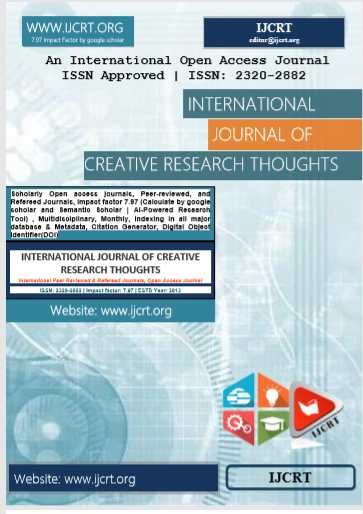 |
 |
|---|---|
| IJCRT Journal front page | IJCRT Journal Back Page |
Paper Title: An Adaptive Trust-Aware Routing Framework Using Deep Reinforcement Learning for Secure Wireless Sensor Networks
Author Name(s): Janaranjani R, Dr. A Senthilkumar
Published Paper ID: - IJCRT2608258
Register Paper ID - 312636
Publisher Journal Name: IJPUBLICATION, IJCRT
DOI Member ID: 10.6084/m9.doi.one.IJCRT2608258 and DOI :
Author Country : Indian Author, India, 637408 , Namakkal, 637408 , | Research Area: Science All Published Paper URL: http://ijcrt.org/viewfull.php?&p_id=IJCRT2608258 Published Paper PDF: download.php?file=IJCRT2608258 Published Paper PDF: http://www.ijcrt.org/papers/IJCRT2608258.pdf
Your Paper Publication Details:
Title: AN ADAPTIVE TRUST-AWARE ROUTING FRAMEWORK USING DEEP REINFORCEMENT LEARNING FOR SECURE WIRELESS SENSOR NETWORKS
DOI (Digital Object Identifier) :
Pubished in Volume: 14 | Issue: 8 | Year: August 2026
Publisher Name : IJCRT | www.ijcrt.org | ISSN : 2320-2882
Subject Area: Science All
Author type: Indian Author
Pubished in Volume: 14
Issue: 8
Pages: c363-c369
Year: August 2026
Downloads: 51
E-ISSN Number: 2320-2882
Abstract
Wireless Sensor Networks (WSNs) are widely used in applications such as environmental monitoring, healthcare, industrial automation, and smart infrastructure. However, the limited energy resources, dynamic network conditions, and vulnerability of sensor nodes create significant challenges for reliable and secure communication. Conventional routing protocols generally rely on static routing decisions and may not effectively respond to changing network conditions or malicious behaviour. This paper proposes an adaptive trust-aware routing framework that integrates trust evaluation with Deep Reinforcement Learning (DRL) to improve routing decisions in wireless sensor networks. The proposed approach continuously evaluates node behaviour based on communication reliability and network characteristics and incorporates the resulting trust information into the routing decision process. A DRL-based agent is designed to learn suitable routing actions according to the current network state, thereby enabling adaptive selection of reliable communication paths. The methodology focuses on improving secure and efficient data transmission while reducing unnecessary routing overhead and energy consumption. The proposed framework is designed to be evaluated using performance measures such as packet delivery ratio, end-to-end delay, energy consumption, routing overhead, and network lifetime. The study provides a methodology-oriented approach for combining intelligent decision-making and trust management in WSN routing and establishes a foundation for future simulation-based validation under different network and security conditions.
Licence: creative commons attribution 4.0
License
Creative Commons Attribution 4.0 and The Open Definition

Keywords
Wireless Sensor Networks, Deep Reinforcement Learning, Trust-Aware Routing, Secure Routing, Energy Efficiency, Adaptive Routing
License
Creative Commons Attribution 4.0 and The Open Definition
Paper Title: The Role of Listening Skills in Shaping Classroom Engagement
Author Name(s): Mehanaz Mahamoodha A, Dr.Shabiya Thaseen
Published Paper ID: - IJCRT2608257
Register Paper ID - 312688
Publisher Journal Name: IJPUBLICATION, IJCRT
DOI Member ID: 10.6084/m9.doi.one.IJCRT2608257 and DOI :
Author Country : Indian Author, India, 600007 , Chennai, 600007 , | Research Area: Others area Published Paper URL: http://ijcrt.org/viewfull.php?&p_id=IJCRT2608257 Published Paper PDF: download.php?file=IJCRT2608257 Published Paper PDF: http://www.ijcrt.org/papers/IJCRT2608257.pdf
Your Paper Publication Details:
Title: THE ROLE OF LISTENING SKILLS IN SHAPING CLASSROOM ENGAGEMENT
DOI (Digital Object Identifier) :
Pubished in Volume: 14 | Issue: 8 | Year: August 2026
Publisher Name : IJCRT | www.ijcrt.org | ISSN : 2320-2882
Subject Area: Others area
Author type: Indian Author
Pubished in Volume: 14
Issue: 8
Pages: c353-c362
Year: August 2026
Downloads: 46
E-ISSN Number: 2320-2882
Abstract
Effective listening is a fundamental communication skill that supports academic comprehension, information processing, and meaningful participation in classroom learning. However, research examining the relationship between listening skills and classroom engagement among Indian secondary school students remains limited. This study aimed to assess listening skills and classroom engagement among students in Grades 9-12 and examine the relationship between these variables. A descriptive cross-sectional design was employed with 160 students recruited through convenience sampling from selected schools in Chennai, Tamil Nadu. Listening skills were measured using the HURIER Listening Profile, and classroom engagement was assessed using the Classroom Engagement Inventory. Data were analysed using descriptive statistics, independent samples t-tests, one-way ANOVA, and Pearson correlation in IBM SPSS Statistics Version 26. The findings indicated that most students demonstrated adequate listening skills across all HURIER dimensions, while classroom engagement was moderately high (M = 72.94, SD = 7.46). Significant gender differences were observed across all listening dimensions, with male students scoring higher than female students. Emotional engagement also differed significantly by gender. However, no significant correlations were found between listening skills and overall classroom engagement or its subscales (p > .05). These findings suggest that although students possess satisfactory listening competencies, listening skills alone may not predict classroom engagement. Other factors, including motivational, interpersonal, and instructional influences, may play a more substantial role in shaping student engagement.
Licence: creative commons attribution 4.0
License
Creative Commons Attribution 4.0 and The Open Definition
Keywords
listening skills, classroom engagement, secondary school students, HURIER model, student engagement, educational psychology.
License
Creative Commons Attribution 4.0 and The Open Definition
Paper Title: Right to Privacy in the Digital Era in India
Author Name(s): Samreen Alvi, Nadeem Alam
Published Paper ID: - IJCRT2608256
Register Paper ID - 312675
Publisher Journal Name: IJPUBLICATION, IJCRT
DOI Member ID: 10.6084/m9.doi.one.IJCRT2608256 and DOI :
Author Country : Indian Author, India, 202002 , Aligarh, 202002 , | Research Area: Medical Science All Published Paper URL: http://ijcrt.org/viewfull.php?&p_id=IJCRT2608256 Published Paper PDF: download.php?file=IJCRT2608256 Published Paper PDF: http://www.ijcrt.org/papers/IJCRT2608256.pdf
Your Paper Publication Details:
Title: RIGHT TO PRIVACY IN THE DIGITAL ERA IN INDIA
DOI (Digital Object Identifier) :
Pubished in Volume: 14 | Issue: 8 | Year: August 2026
Publisher Name : IJCRT | www.ijcrt.org | ISSN : 2320-2882
Subject Area: Medical Science All
Author type: Indian Author
Pubished in Volume: 14
Issue: 8
Pages: c336-c352
Year: August 2026
Downloads: 94
E-ISSN Number: 2320-2882
Abstract
For more than sixty years it was unclear whether the Constitution of India protected privacy at all. That uncertainty ended on 24 August 2017, when a nine-judge bench of the Supreme Court in Justice K. S. Puttaswamy (Retd.) v. Union of India unanimously held that privacy is a fundamental right flowing from Articles 14, 19 and 21, and that any interference by the State must satisfy the tests of legality, legitimate aim, proportionality and adequate procedural safeguards. Parliament responded only in 2023, and the Rules giving effect to that statute were notified on 13 November 2025, under which the main duties of data fiduciaries become binding only by 13 May 2027. The research problem is the distance between what the Constitution now promises and what the statutory framework delivers. The study traces the evolution of privacy in Indian constitutional jurisprudence, examines the statutory framework now governing personal data and State surveillance, measures digital expansion and privacy-related harm from official data, and sets the Indian framework against the General Data Protection Regulation. The central question is whether the Digital Personal Data Protection Act, 2023 satisfies the proportionality standard laid down in Puttaswamy. The hypothesis is that constitutional recognition of privacy in India has outpaced its statutory realisation, and that the present framework disciplines private data fiduciaries far more effectively than it disciplines the State. The design is doctrinal and descriptive-analytical, and uses secondary data only, drawn from peer-reviewed journal articles, academic books, reported judgments, and official reports of TRAI, the National Crime Records Bureau, UIDAI, the Reserve Bank of India, CERT-In, MeitY, the World Bank, UNCTAD and the ITU. Thematic analysis, doctrinal analysis and descriptive statistics have been applied, and every figure has been traced to a named official publication. Six findings emerge. Broadband subscribers rose from 131.49 million in November 2015 to 1,065.88 million by March 2026. Cybercrime cases registered by the National Crime Records Bureau rose from 52,974 in 2021 to 86,420 in 2023, an increase of about 63 per cent in two years. A wide urban-rural gap persists, with tele-density of 151.47 per cent in urban India against 60.46 per cent in rural India in March 2026, which limits the usefulness of a consent-based law. The Indian statute is narrower than the General Data Protection Regulation, providing no right to data portability, no separate category of sensitive personal data and no safeguard against automated decision-making. Broad State exemptions under Section 17, an executive-appointed Data Protection Board and the amendment of the Right to Information Act, 2005 by Section 44(3) weaken accountability. Most significantly, no surveillance reform has followed Puttaswamy: interception under Section 69 of the Information Technology Act, 2000 and Section 5(2) of the Indian Telegraph Act, 1885 still requires no prior judicial authorisation. The paper concludes that the constitutional promise of 2017 remains only partly realised. It recommends an independent regulator, prior judicial authorisation for interception, restoration of the public-interest override in the Right to Information Act, a safeguard against automated decisions, and digital literacy in regional languages so that consent becomes meaningful.
Licence: creative commons attribution 4.0
License
Creative Commons Attribution 4.0 and The Open Definition
Keywords
right to privacy; Puttaswamy; Digital Personal Data Protection Act 2023; surveillance; data protection; proportionality; digital India
License
Creative Commons Attribution 4.0 and The Open Definition
Paper Title: TRENDS IN FEMALE LABOUR FORCE PARTICIPATION RATE
Author Name(s): Dr. Ganta Suresh Babu
Published Paper ID: - IJCRT2608255
Register Paper ID - 312632
Publisher Journal Name: IJPUBLICATION, IJCRT
DOI Member ID: 10.6084/m9.doi.one.IJCRT2608255 and DOI :
Author Country : Indian Author, India, 521135 , movva, 521135 , | Research Area: Arts1 All Published Paper URL: http://ijcrt.org/viewfull.php?&p_id=IJCRT2608255 Published Paper PDF: download.php?file=IJCRT2608255 Published Paper PDF: http://www.ijcrt.org/papers/IJCRT2608255.pdf
Your Paper Publication Details:
Title: TRENDS IN FEMALE LABOUR FORCE PARTICIPATION RATE
DOI (Digital Object Identifier) :
Pubished in Volume: 14 | Issue: 8 | Year: August 2026
Publisher Name : IJCRT | www.ijcrt.org | ISSN : 2320-2882
Subject Area: Arts1 All
Author type: Indian Author
Pubished in Volume: 14
Issue: 8
Pages: c324-c335
Year: August 2026
Downloads: 134
E-ISSN Number: 2320-2882
Abstract
Female labour force participation is an important indicator of women's economic empowerment, gender equality, and inclusive economic development. Despite improvements in women's education and socioeconomic conditions, female participation in the labour market in India continues to remain substantially below male participation, with considerable variations across rural and urban areas, age groups, and states. The present study examines the trends and patterns of female labour force participation in India using secondary data obtained from the Census of India and the Periodic Labour Force Survey (PLFS) published by the Ministry of Statistics and Programme Implementation (MoSPI). The study analyses historical rural female work participation and recent labour force participation rates under usual status and current weekly status, with particular attention to women aged 15 years and above and young women aged 15-29 years. The findings indicate an overall improvement in female labour force participation in recent years, particularly in rural areas. However, substantial gender and rural-urban disparities continue to persist. Female participation among young women remains considerably lower than male participation, while significant interstate variations are also observed. Andhra Pradesh records a female labour force participation rate among young women that is above the national average, although a considerable gender gap remains. The findings suggest that the recent rise in female labour force participation should be assessed not only in terms of increased participation but also in relation to the nature, security, and quality of employment. The study emphasizes the need for policies promoting education and skill development, decent employment, entrepreneurship, childcare support, workplace safety, social security, and equal employment opportunities to achieve sustained and meaningful improvement in women's participation in India's labour market.
Licence: creative commons attribution 4.0
License
Creative Commons Attribution 4.0 and The Open Definition
Keywords
Female Labour Force Participation, Rural-Urban Disparities, Periodic Labour Force Survey
License
Creative Commons Attribution 4.0 and The Open Definition
Paper Title: Child Protection In The Age Of Generative Ai: Rethinking Pocso And Intermediary Liability In India
Author Name(s): Dr. Sheena Thomas, Dr. Bharati G Ganawari
Published Paper ID: - IJCRT2608254
Register Paper ID - 312671
Publisher Journal Name: IJPUBLICATION, IJCRT
DOI Member ID: 10.6084/m9.doi.one.IJCRT2608254 and DOI :
Author Country : Indian Author, India, 573211 , Holenarasipura, 573211 , | Research Area: Social Science All Published Paper URL: http://ijcrt.org/viewfull.php?&p_id=IJCRT2608254 Published Paper PDF: download.php?file=IJCRT2608254 Published Paper PDF: http://www.ijcrt.org/papers/IJCRT2608254.pdf
Your Paper Publication Details:
Title: CHILD PROTECTION IN THE AGE OF GENERATIVE AI: RETHINKING POCSO AND INTERMEDIARY LIABILITY IN INDIA
DOI (Digital Object Identifier) :
Pubished in Volume: 14 | Issue: 8 | Year: August 2026
Publisher Name : IJCRT | www.ijcrt.org | ISSN : 2320-2882
Subject Area: Social Science All
Author type: Indian Author
Pubished in Volume: 14
Issue: 8
Pages: c312-c323
Year: August 2026
Downloads: 62
E-ISSN Number: 2320-2882
Abstract
The rapid transformation of the digital environment has changed not only how children communicate and participate online, but also how child sexual exploitation and abuse material (CSEAM) can be created, stored, shared and repeatedly circulated. Social-media platforms, messaging services, cloud infrastructure and, more recently, generative artificial intelligence have created digital spaces in which harmful material can travel across borders within seconds and remain accessible long after the original abuse has occurred. The continuing circulation of such material can therefore prolong the violation of a child's dignity, privacy and personal security. These developments raise an increasingly difficult legal question as to what extent should online platforms be held responsible for unlawful material that they did not themselves create but that is transmitted or hosted through their services? This question has gained particular significance in India following the Supreme Court's decision in Just Rights for Children Alliance & Anr. v. S. Harish & Ors., 2024 INSC 716, which adopted a broader understanding of digital possession in the context of child sexual-abuse material under the Protection of Children from Sexual Offences Act, 2012 (POCSO). The Court's reasoning demonstrated the need to interpret child-protection law in light of contemporary digital realities. The issue has now moved towards a more complex institutional question. In 2026, the Supreme Court agreed to examine a plea concerning the possible prosecution of online platforms under POCSO in cases involving the hosting of, or failure to report, child sexual-abuse material. Although the proceedings remain pending and do not establish criminal liability against intermediaries, they bring into sharper focus the relationship between POCSO's reporting obligations and the conditional safe-harbour protection available under the Information Technology Act, 2000. Generative artificial intelligence further complicates this legal landscape. AI-generated images, manipulated photographs, synthetic videos and other forms of digitally fabricated sexual material involving children challenge conventional understandings of creation, possession and dissemination. This article examines these developments through the broader framework of intermediary liability, platform governance and digital constitutionalism. It argues that Indian law should move beyond the rigid choice between intermediary immunity and automatic platform liability and instead adopt a proportionate, capability-based model of responsibility. Under this approach, platform responsibility would be assessed in light of knowledge, technological capability, and degree of control, foreseeable risk and compliance with statutory duties. Such a framework can strengthen child protection while preserving the constitutional values of privacy, freedom of expression, due process and responsible technological innovation.
Licence: creative commons attribution 4.0
License
Creative Commons Attribution 4.0 and The Open Definition
Keywords
Keywords: POCSO, intermediary liability, child sexual abuse material, CSEAM, artificial intelligence, generative AI, platform governance, safe harbor, digital constitutionalism, India.
License
Creative Commons Attribution 4.0 and The Open Definition
Paper Title: Neutrosophic Pythagorean Cubic Soft Set Algebra
Author Name(s): Lydia B, Stanis Arul Mary A
Published Paper ID: - IJCRT2608253
Register Paper ID - 312693
Publisher Journal Name: IJPUBLICATION, IJCRT
DOI Member ID: 10.6084/m9.doi.one.IJCRT2608253 and DOI :
Author Country : Indian Author, India, 641018 , Coimbatore, 641018 , | Research Area: Mathematics All Published Paper URL: http://ijcrt.org/viewfull.php?&p_id=IJCRT2608253 Published Paper PDF: download.php?file=IJCRT2608253 Published Paper PDF: http://www.ijcrt.org/papers/IJCRT2608253.pdf
Your Paper Publication Details:
Title: NEUTROSOPHIC PYTHAGOREAN CUBIC SOFT SET ALGEBRA
DOI (Digital Object Identifier) :
Pubished in Volume: 14 | Issue: 8 | Year: August 2026
Publisher Name : IJCRT | www.ijcrt.org | ISSN : 2320-2882
Subject Area: Mathematics All
Author type: Indian Author
Pubished in Volume: 14
Issue: 8
Pages: c303-c311
Year: August 2026
Downloads: 63
E-ISSN Number: 2320-2882
Abstract
This study examines, the structural aspects of Neutrosophic Pythagorean Cubic Soft Sets in the context of BCK/BCI-algebra and subalgebras along with their related properties. Moreover, we present several significant results associated with them.
Licence: creative commons attribution 4.0
License
Creative Commons Attribution 4.0 and The Open Definition
Keywords
NPCSS, NPCSS BCK/BCI algebra
License
Creative Commons Attribution 4.0 and The Open Definition
Paper Title: The psychological perspective on migration from village to city in Premchand's Godan: Changing paradigms of self-reliance and exploitation
Author Name(s): Milli Rani Paul
Published Paper ID: - IJCRT2608252
Register Paper ID - 312383
Publisher Journal Name: IJPUBLICATION, IJCRT
DOI Member ID: 10.6084/m9.doi.one.IJCRT2608252 and DOI :
Author Country : Indian Author, India, 799001 , Agartala, 799001 , | Research Area: Medical Science All Published Paper URL: http://ijcrt.org/viewfull.php?&p_id=IJCRT2608252 Published Paper PDF: download.php?file=IJCRT2608252 Published Paper PDF: http://www.ijcrt.org/papers/IJCRT2608252.pdf
Your Paper Publication Details:
Title: THE PSYCHOLOGICAL PERSPECTIVE ON MIGRATION FROM VILLAGE TO CITY IN PREMCHAND'S GODAN: CHANGING PARADIGMS OF SELF-RELIANCE AND EXPLOITATION
DOI (Digital Object Identifier) :
Pubished in Volume: 14 | Issue: 8 | Year: August 2026
Publisher Name : IJCRT | www.ijcrt.org | ISSN : 2320-2882
Subject Area: Medical Science All
Author type: Indian Author
Pubished in Volume: 14
Issue: 8
Pages: c298-c302
Year: August 2026
Downloads: 80
E-ISSN Number: 2320-2882
Abstract
This paper examines the psychoanalysis of displacement in Munshi Premchand's Godan, focusing on the illusion of self-reliance, identity crisis, and changing paradigms of exploitation. Displacement is interpreted not merely as geographical migration but as a psychological and socio-economic condition that reshapes individual consciousness. Through a psychoanalytic approach, the study explores how Hori's aspiration for dignity and self-reliance gradually transforms into alienation under the pressures of caste, class, debt, and social hierarchy. The paper argues that the promise of self-reliance often conceals deeper mechanisms of exploitation, resulting in fractured identity and persistent psychological conflict. By integrating literary analysis with psychoanalytic theory, the study highlights the enduring relevance of Godan in understanding the psychological dimensions of displacement and exploitation in both colonial and contemporary contexts. The research contributes to interdisciplinary discussions on Hindi literature, psychology, and migration studies.
Licence: creative commons attribution 4.0
License
Creative Commons Attribution 4.0 and The Open Definition
Keywords
Godan, Munshi Premchand, Displacement, Psychoanalysis, Identity Crisis, Exploitation, Hindi Literature, Migration, Social Psychology
License
Creative Commons Attribution 4.0 and The Open Definition
Paper Title: Prachin Bharat Mein Jal Sansadhan Prabandhan Aur Paramparik Jal Pranaliyan: Ek Avalokan
Author Name(s): Dr. Birendramani Tripathi
Published Paper ID: - IJCRT2608251
Register Paper ID - 312622
Publisher Journal Name: IJPUBLICATION, IJCRT
DOI Member ID: 10.6084/m9.doi.one.IJCRT2608251 and DOI :
Author Country : Indian Author, India, - , -, - , | Research Area: Arts All Published Paper URL: http://ijcrt.org/viewfull.php?&p_id=IJCRT2608251 Published Paper PDF: download.php?file=IJCRT2608251 Published Paper PDF: http://www.ijcrt.org/papers/IJCRT2608251.pdf
Your Paper Publication Details:
Title: PRACHIN BHARAT MEIN JAL SANSADHAN PRABANDHAN AUR PARAMPARIK JAL PRANALIYAN: EK AVALOKAN
DOI (Digital Object Identifier) :
Pubished in Volume: 14 | Issue: 8 | Year: August 2026
Publisher Name : IJCRT | www.ijcrt.org | ISSN : 2320-2882
Subject Area: Arts All
Author type: Indian Author
Pubished in Volume: 14
Issue: 8
Pages: c289-c297
Year: August 2026
Downloads: 82
E-ISSN Number: 2320-2882
Abstract
Prachin Bharat Mein Jal Sansadhan Prabandhan Aur Paramparik Jal Pranaliyan: Ek Avalokan
Licence: creative commons attribution 4.0
License
Creative Commons Attribution 4.0 and The Open Definition
Keywords
Prachin Bharat Mein Jal Sansadhan Prabandhan Aur Paramparik Jal Pranaliyan: Ek Avalokan
License
Creative Commons Attribution 4.0 and The Open Definition
Paper Title: Digital Learning Adoption and Constraints among Higher Education Students: An Empirical Study
Author Name(s): Dr.T.S.Kavitha
Published Paper ID: - IJCRT2608250
Register Paper ID - 312685
Publisher Journal Name: IJPUBLICATION, IJCRT
DOI Member ID: 10.6084/m9.doi.one.IJCRT2608250 and DOI :
Author Country : Indian Author, India, 642001 , Pollachi, 642001 , | Research Area: Management All Published Paper URL: http://ijcrt.org/viewfull.php?&p_id=IJCRT2608250 Published Paper PDF: download.php?file=IJCRT2608250 Published Paper PDF: http://www.ijcrt.org/papers/IJCRT2608250.pdf
Your Paper Publication Details:
Title: DIGITAL LEARNING ADOPTION AND CONSTRAINTS AMONG HIGHER EDUCATION STUDENTS: AN EMPIRICAL STUDY
DOI (Digital Object Identifier) :
Pubished in Volume: 14 | Issue: 8 | Year: August 2026
Publisher Name : IJCRT | www.ijcrt.org | ISSN : 2320-2882
Subject Area: Management All
Author type: Indian Author
Pubished in Volume: 14
Issue: 8
Pages: c283-c288
Year: August 2026
Downloads: 60
E-ISSN Number: 2320-2882
Abstract
The digital transformation of higher education has expanded students' access to search engines, learning management systems, online courses, video resources, virtual meeting platforms, electronic scholarly resources and artificial intelligence applications. This study examines the pattern of digital tool usage and the major challenges faced by higher education students in using digital technologies for learning. The analysis is based on 564 responses collected from Higher education pursuing students from Coimbatore District. The Analysis shows that Google Search has the highest mean usage score, followed by SWAYAM/NPTEL) and Google Classroom. YouTube and AI Chat Bots share a mean of, while zoom/Google Meet and online libraries/e-journals record lower values respectively. The study also examines barriers measured on a five-point scale. The results reveal a strong preference for accessible and user-friendly digital resources, while scholarly e-resources and synchronous platforms are comparatively underused. The findings highlight the need to improve digital infrastructure, affordability, training, academic resource awareness and responsible technology use.
Licence: creative commons attribution 4.0
License
Creative Commons Attribution 4.0 and The Open Definition
Keywords
Digital learning tools, higher education, SWAYAM, NPTEL, Google Classroom, AI chatbots, e-resources, digital barriers
License
Creative Commons Attribution 4.0 and The Open Definition
Paper Title: A Comparative Study of Anxiety and Pain Perception among Hospitalized Children Receiving a Structured Play-Based and Therapeutic Communication Intervention in Selected Tertiary Care Hospitals of Roorkee, Uttarakhand
Author Name(s): Jiya K. Mathew, Dr. Manoj Prajapati
Published Paper ID: - IJCRT2608249
Register Paper ID - 312674
Publisher Journal Name: IJPUBLICATION, IJCRT
DOI Member ID: 10.6084/m9.doi.one.IJCRT2608249 and DOI :
Author Country : Indian Author, India, 452016 , Indore, 452016 , | Research Area: Humanities All Published Paper URL: http://ijcrt.org/viewfull.php?&p_id=IJCRT2608249 Published Paper PDF: download.php?file=IJCRT2608249 Published Paper PDF: http://www.ijcrt.org/papers/IJCRT2608249.pdf
Your Paper Publication Details:
Title: A COMPARATIVE STUDY OF ANXIETY AND PAIN PERCEPTION AMONG HOSPITALIZED CHILDREN RECEIVING A STRUCTURED PLAY-BASED AND THERAPEUTIC COMMUNICATION INTERVENTION IN SELECTED TERTIARY CARE HOSPITALS OF ROORKEE, UTTARAKHAND
DOI (Digital Object Identifier) :
Pubished in Volume: 14 | Issue: 8 | Year: August 2026
Publisher Name : IJCRT | www.ijcrt.org | ISSN : 2320-2882
Subject Area: Humanities All
Author type: Indian Author
Pubished in Volume: 14
Issue: 8
Pages: c276-c282
Year: August 2026
Downloads: 53
E-ISSN Number: 2320-2882
Abstract
Licence: creative commons attribution 4.0
License
Creative Commons Attribution 4.0 and The Open Definition
Keywords
Hospitalized children; Anxiety; Pain perception; Structured play; Therapeutic communication; Pediatric nursing; Randomized controlled trial.
License
Creative Commons Attribution 4.0 and The Open Definition
Call For Paper September 2026
Call For Papers
September 2026
Volume 14 | Issue 9
Last Date :
31-Oct-2026
Submit Manuscript Online Impact Factor: 7.97 Review Results : Within 02-03 Days Paper Publication : Within 02-03 Days
September 2026
Volume 14 | Issue 9
Last Date :
31-Oct-2026
Submit Manuscript Online Impact Factor: 7.97 Review Results : Within 02-03 Days Paper Publication : Within 02-03 Days
Published Issue Details
For Authors
Forms / Downloads
Other IMP Links
Indexing Partner
Research Area
LICENSE





ISSN and 7.97 Impact Factor Details
ISSN: 2320-2882 Impact Factor: 7.97 and ISSN APPROVED Journal Starting Year (ESTD) : 2013


ISSN and 7.97 Impact Factor Details
ISSN: 2320-2882 Impact Factor: 7.97 and ISSN APPROVED Journal Starting Year (ESTD) : 2013
DOI Details
CONFERENCE
CONFERENCE MANAGMENT & PUBLICATION CONFERENCE PROPOSAL
RECENT CONFERENCE

CONFERENCE PROPOSAL CONFERENCE PROCEEDINGS
CONFERENCE PROPOSAL CONFERENCE PROCEEDINGS
For Reviewer /Referral (RMS) Earn 500 per paper
Important Links
NEWS & Conference
Digital Library
IJCRT RMS | Earn 500 Per Paper.

Open Access


LICENSE
Indexing Partner
Scholarly open access journals, Peer-reviewed, and Refereed Journals, Impact factor 7.97 (Calculate by google scholar and Semantic Scholar | AI-Powered Research Tool) , Multidisciplinary, Monthly, Indexing in all major database & Metadata, Citation Generator, Digital Object Identifier(DOI)